

NEW JERSEY RETIREMENT TAXES
New Jersey Roth Conversions
A Roth conversion moves money from a traditional IRA into a Roth IRA, with the taxable portion included in income for the conversion year. For New Jersey residents, federal and state taxable amounts can differ. The decision brings together today’s tax cost, future withdrawals and the cash available to pay the bill.
Educational guide | Sources verified October 5, 2026
Specific individualized tax advice not provided. We suggest that you discuss your specific tax issues with a qualified tax advisor.
The Roth conversion window
When wages stop, taxable income may fall before required minimum distributions begin. That lower-income stretch can be an opportunity to evaluate Roth conversions. Later distributions or a change in filing status may increase the tax cost of traditional IRA withdrawals.
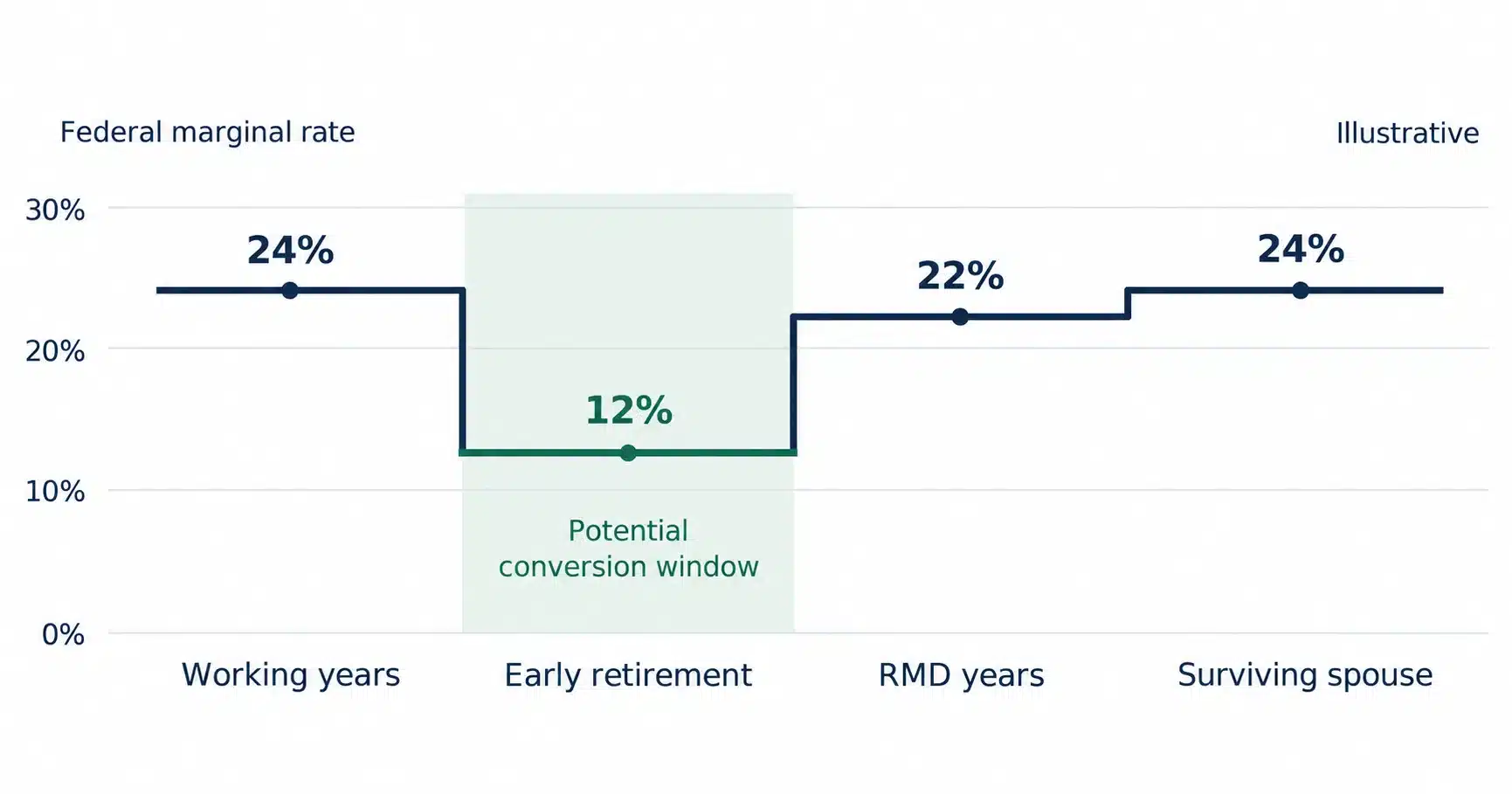
Illustrative example using 2026 federal marginal brackets at every stage, not a forecast. Actual income, timing and tax rates vary. Select the chart to enlarge.

See the example’s income assumptions
- Working years: $250,000 of joint taxable income, 24% marginal bracket.
- Early retirement: $80,000 of joint taxable income, 12% marginal bracket.
- RMD years: $160,000 of joint taxable income, 22% marginal bracket.
- Surviving spouse: $125,000 of taxable income, later filing single, 24% marginal bracket.
These are hypothetical ordinary-income amounts after deductions and before conversions. The same 2026 brackets are used throughout. The stages do not imply equal durations or a universal sequence.
Less income can still mean a higher bracket
In the example, the surviving spouse has less taxable income but reaches a higher bracket because single-filer brackets are narrower. The example assumes later eligible single filing. Joint filing may remain available for the year of death; qualifying surviving spouse status can preserve joint rates for two following years when its requirements are met, including qualifying-child requirements.
Marginal rates do not apply to all income. A conversion itself adds taxable income and may cross bracket thresholds. New Jersey tax, Medicare premiums and other income effects must be evaluated separately. A lower federal bracket does not establish how much, or whether, to convert.
Sources: IRS: 2026 federal tax brackets, Rev. Proc. 2025-32; IRS: Publication 501 (2025), filing status; IRS: RMD FAQs.
How does a conversion differ from a contribution or withdrawal?
Contribution: add new savings
A regular Roth IRA contribution adds new money. It requires eligible compensation, is subject to an annual contribution limit, and can be restricted by income and filing status.
Conversion: change the account’s tax treatment
A conversion transfers existing retirement money into a Roth IRA. It does not use the regular annual contribution limit or require earned income. The income restrictions for direct Roth IRA contributions do not apply to conversions, but eligibility and transfer rules still matter.
Withdrawal: take money out
A withdrawal distributes money from the account. A qualified Roth IRA withdrawal is tax-free federally and in New Jersey. A nonqualified withdrawal can have tax consequences; New Jersey’s calculation can differ from the federal ordering rules.
This guide focuses on traditional IRA conversions. Employer-plan rollovers and in-plan Roth conversions have additional plan rules. A “backdoor Roth” typically combines a nondeductible traditional IRA contribution with a conversion; it does not bypass the federal rules for existing IRA balances.
Sources: IRS: Roth IRAs; IRS: IRA FAQs; IRS: Form 8606 instructions (2025); NJ Division of Taxation: Roth IRAs, TB-44(R).
Traditional IRA account owners have considerations to make before performing a Roth IRA conversion. These primarily include income tax consequences on the converted amount in the year of conversion, withdrawal limitations from a Roth IRA, and income limitations for future contributions to a Roth IRA. In addition, if you are required to take a required minimum distribution (RMD) in the year you convert, you must do so before converting to a Roth IRA.
How is a conversion taxed federally and in New Jersey?
Federal tax
- Taxable amount: Money not already taxed is generally ordinary income, rather than a capital gain.
- Your basis: Form 8606 tracks nondeductible traditional IRA contributions.
- The pro rata rule: The calculation includes your traditional, SEP and SIMPLE IRAs and year-end balances. Converting one account does not let you isolate only previously taxed dollars.
- Spouses: Each spouse’s IRAs are calculated separately.
Sources: IRS: Form 8606 instructions (2025).
New Jersey tax
- Your contribution history: New Jersey generally does not allow a deduction for personal IRA contributions. Those previously taxed contributions are not taxed again when converted; earnings and amounts not previously taxed by New Jersey are included in state income.
- Rollovers: Pretax 401(k) money rolled into an IRA can have a different state tax history from personal IRA contributions.
- Your records: Contributions, rollovers and earlier withdrawals establish unrecovered state basis. The federal amount on Form 1099-R does not automatically establish the New Jersey amount.
- Partial conversions: Apply the state IRA calculation. You cannot simply select only previously taxed dollars.
Sources: NJ Division of Taxation: Retirement Income, GIT-1 & 2 (January 2026); NJ Division of Taxation: Roth IRAs, TB-44(R).
Check the retirement income exclusion too
For an eligible household, New Jersey’s pension exclusion may offset qualifying taxable IRA income. The taxable conversion can also increase the total income used to determine eligibility and reduce or eliminate the exclusion. Age or disability, filing status and the qualified spouse’s income matter. Model the conversion and the rest of the household’s income together before assuming any state exclusion applies.
Sources: NJ Division of Taxation: Retirement Income Exclusions.
When might a conversion fit, and when might it not?
A comparison should include leaving the account unchanged, converting a smaller amount, and spreading conversions across years. A lower federal bracket alone does not settle the decision.
Reasons to consider a conversion
- A lower-income year may offer a lower tax cost than a later withdrawal, depending on future income and tax rules.
- Money in a Roth IRA may add flexibility when choosing how to fund retirement expenses.
- Moving money out of a traditional IRA may reduce the balance used for future RMD calculations. Roth IRA owners have no lifetime RMDs.
Reasons to limit, defer or avoid one
- The conversion may cost more in tax now than leaving the money for later withdrawals.
- Paying the tax may strain cash reserves, or the money may be needed before the withdrawal rules are satisfied.
- Conversion income may affect Medicare premiums, tax benefits or New Jersey exclusion eligibility. Future residence and tax rates remain uncertain.
Future savings depend on assumptions that may change. A conversion does not guarantee a lower lifetime tax bill, and a Roth account does not remove investment risk.
Sources: IRS: RMD FAQs.
What else can conversion income affect?
Medicare premiums
The taxable federal conversion increases adjusted gross income even when the money goes directly into the Roth IRA. Medicare’s income-related monthly adjustment amount, or IRMAA, uses modified adjusted gross income: adjusted gross income plus tax-exempt interest. Social Security generally uses tax information from two years earlier for Part B and Part D adjustments.
A conversion in 2026 can therefore affect premiums in 2028 under the usual lookback. Use the thresholds for the premium year being evaluated when they are available. A voluntary conversion by itself is not one of Social Security’s listed life-changing events for requesting a new determination.
Sources: SSA: Medicare premiums and higher-income beneficiaries.
Social Security
Additional income can make more of your Social Security benefits taxable federally. New Jersey does not tax Social Security benefits, but it can still tax the conversion itself.
Sources: IRS: Taxation of Social Security benefits; NJ Division of Taxation: Retirement Income, GIT-1 & 2 (January 2026).
Other taxes and benefits
A conversion can also affect income-based deductions and credits and the rate applied to capital gains. The conversion is generally not net investment income for the Net Investment Income Tax, but it can increase modified adjusted gross income enough to expose other investment income to that tax. The relevant income definition is not the same for every rule.
Sources: IRS: Capital gains and losses; IRS: Net Investment Income Tax questions and answers.
What do the two five-year rules mean?
One clock concerns tax-free earnings. The other concerns a possible early-withdrawal tax on converted money.
Qualified-withdrawal clock: tax-free earnings
Completing this clock is one requirement for withdrawing Roth IRA earnings free of federal income tax.
- When it starts: January 1 of your first Roth IRA contribution tax year, including a conversion. Later conversions or new Roth IRAs do not restart it.
- What must be met: Five tax years and age 59½. Disability, death or a qualifying first-home withdrawal (up to the $10,000 lifetime limit) can meet the second requirement instead.
- Before you qualify: Earnings withdrawals generally are taxable and may also face a 10% additional tax before age 59½ unless an exception applies.
Why age 59½ alone is not enough
You are 60 when you first fund a Roth IRA through a 2026 conversion. Its five-tax-year period is satisfied January 1, 2031.
- Before January 1, 2031: Earnings withdrawn generally are federally taxable, even though you are over 59½.
- From January 1, 2031: Both the age and five-year requirements are met, so earnings withdrawals qualify for tax-free federal treatment.
Sources: IRS: Form 8606 instructions (2025); IRS: Publication 590-B (2025); IRS: Additional tax on early distributions, Topic 557.
Conversion clock: possible early-withdrawal tax
This separate clock matters if you withdraw converted money before age 59½.
- When it starts: Each conversion has its own five-tax-year period beginning January 1 of the conversion year.
- What it changes: Withdrawing the portion taxed at conversion within that period can trigger a 10% federal additional tax unless an exception applies. It does not make that converted principal taxable as income again.
- At age 59½: This early-withdrawal tax no longer applies, but the qualified-withdrawal clock still matters for earnings.
Federal ordering rules generally treat regular contributions as withdrawn first, then conversions, then earnings. Regular contributions can generally be withdrawn without federal income tax or the 10% additional tax; converted money has the separate rule above.
Sources: IRS: Publication 590-B (2025).
New Jersey has its own calculation for nonqualified Roth IRA withdrawals. Federal treatment alone does not settle the state result.
How do taxes, RMDs and timing fit together?
Plan how to pay the tax
Cash outside the retirement account can pay the conversion tax while allowing the intended amount to reach the Roth IRA. That choice still has a cost: it uses cash that could serve other needs. Selling assets to raise the cash can create additional taxable gains.
If tax is withheld from an IRA distribution, that portion does not reach the Roth IRA. It can also be subject to the federal early-distribution tax when you are under age 59½ and no exception applies. Review federal and New Jersey estimated payments or withholding before the transaction; waiting until the return is filed may create an underpayment penalty.
Sources: IRS: Publication 590-A (2025).
Complete the RMD first
If an RMD is due for the year, satisfy the applicable RMD before converting additional eligible IRA money. An RMD cannot be rolled into a Roth IRA, and a conversion does not satisfy it. A conversion does not erase the current year’s RMD.
Sources: IRS: IRA FAQs; IRS: RMD FAQs.
Confirm timing before transferring money
A direct custodian transfer avoids personally handling the distribution and the 60-day rollover deadline. For a direct conversion intended for the current calendar tax year, allow time for the custodian to complete it by December 31. The prior-year contribution deadline does not let you designate a later direct conversion for the prior year.
A completed conversion cannot be undone by recharacterizing it back to a traditional IRA. Compare the projected full-year tax result before the transfer, including wages, pensions, gains and other withdrawals.
Sources: IRS: IRA FAQs; IRS: Publication 590-A (2025); IRS: Form 8606 instructions (2025).
What should you review before a conversion?
- Account history: federal Form 8606 basis, New Jersey contributions already taxed, past withdrawals and rollover records.
- Full-year income: expected wages, pensions, Social Security, gains, withdrawals and any RMD.
- The full cost: federal and state tax, Medicare effects, income-based tax benefits and cash needed for payments.
- Access to the money: your age, first Roth IRA funding year, conversion years and likely spending needs.
- Alternatives: no conversion, a smaller conversion or a different year, using realistic assumptions about future income and residence.
- Execution and records: custodian processing dates, payment arrangements, Form 1099-R, Form 5498 and the required tax reporting.
At Retirement Refined, Roth conversion analysis is part of coordinating retirement income and tax planning. A planning conversation can help frame the alternatives alongside the tax professional who advises on your return.
Keep reading
Important disclosures
Specific individualized tax advice not provided. We suggest that you discuss your specific tax issues with a qualified tax advisor.
This guide provides general education and is not individualized tax, legal or investment advice. Tax treatment depends on your circumstances and may change. Investing involves risk, including loss of principal.
Securities and advisory services offered through LPL Financial, Member FINRA/SIPC and a Registered Investment Advisor.
Sources and verification
Sources verified October 5, 2026. IRS Publications 590-A, 590-B and 501 and the Form 8606 instructions linked here are the 2025 editions available at verification. The New Jersey retirement bulletin is dated January 2026; TB-44(R) is older guidance cross-checked against it.
- IRS: Roth IRAs
- IRS: IRA FAQs
- IRS: Publication 590-A (2025)
- IRS: Publication 590-B (2025)
- IRS: Form 8606 instructions (2025)
- NJ Division of Taxation: Retirement Income, GIT-1 & 2 (January 2026)
- NJ Division of Taxation: Roth IRAs, TB-44(R)
- NJ Division of Taxation: Retirement Income Exclusions
- IRS: RMD FAQs
- SSA: Medicare premiums and higher-income beneficiaries
- IRS: Taxation of Social Security benefits
- IRS: Capital gains and losses
- IRS: Net Investment Income Tax questions and answers
- IRS: 2026 federal tax brackets, Rev. Proc. 2025-32
- IRS: Publication 501 (2025), filing status
- IRS: Additional tax on early distributions, Topic 557
The chart uses hypothetical taxable ordinary income and the 2026 federal marginal brackets at every stage. Recheck current rules and applicable tax-year forms before acting. Medicare thresholds change by premium year.

ABOUT THE AUTHOR
Paul Levin, CFP®, ChFC®, RICP®*, TPCP®
Managing Principal, Retirement Refined
Paul Levin, CFP®, ChFC®, RICP®, TPCP® is the Managing Principal of Retirement Refined, a financial planning and wealth management firm based in Cherry Hill, New Jersey. With more than three decades of experience, Paul works with individuals, families, and business owners on retirement planning, retirement income, investment management, and related financial decisions.
*RICP® conferred by The American College.